

I've Got Some Bad News: The Ralph Fiennes Odyssey Adaptation Is... OK.
I KNOW. I know.

This is PopPoetry’s Epic Summer Odyssey: We’re looking back at silver screen adaptations of Homer’s famous poem in the run-up to the film event of 2026: Christopher Nolan’s The Odyssey. Subscribe to get each weekly installment of the series delivered to your inbox.
Upgrade to a paid subscription to become a part of the PopPoetry (Audio)Book Club! This summer, we’re listening to Claire Danes narrate Emily Wilson’s translation of The Odyssey.
Friends, I’ve spent the summer with The Odyssey, and it ain’t over yet. By tomorrow I will have watched more than 10 hours of Odyssey adaptations, because Christopher Nolan was like, fuck it, I’ll make a 3-hour film based on an ancient poem. (At 172 minutes, it’s Nolan’s second-longest movie.) Mr. PopPoetry and I have tickets tonight to see the new Odyssey film that’s getting both rave and scathing reviews, depending on where you look. I’ll give you the rundown in next week’s post!
The final Odyssey adaptation I watched in the run-up to the release of Nolan’s Odyssey is quite recent: 2024’s The Return. I’ve wondered if Nolan felt any pressure radiating off this film due to its recency, the star power of its leads, and its visual quality.
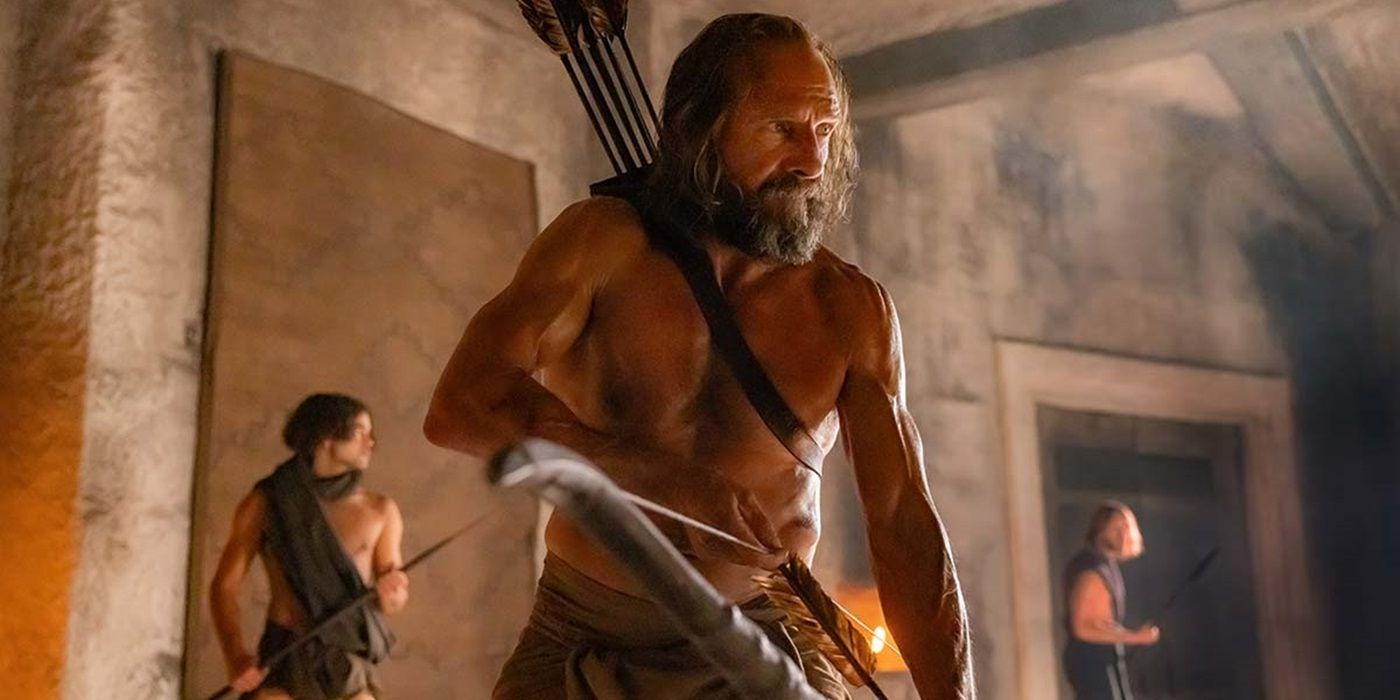
This was, by far, the adaptation I was most interested in watching. I knew O Brother would be good and felt like I could guess what I might be getting into with Ulysses and Nostos, but The Return was terra incognita.
Here’s the bottom line: it’s very good, but it’s very narrow.
The Return (But Just the Return Part)
Two exceptional actors take center stage here: Ralph Fiennes plays our hero Odysseus, and the luminous Juliette Binoche plays Penelope, a casting Fiennes reportedly suggested (their third film together). Directed by Uberto Pasolini (The Italians! They love The Odyssey!) of The Full Monty fame, The Return is a slow burn in the truest sense. Odysseus returns home at the film’s outset, but he doesn’t really return until the film’s end almost two hours later.
While the Odyssey as a poem is itself interested in the question of what it really means (or takes) to fully “come home,” the pace of Odysseus’ homecoming is slow. It’s really, really slow. The “return” portion of the original poem is also very long, but as a film the return almost can’t bear the weight of this kind of narrow focus.
Shot on a budget of $20 million (that’s just 8% of Christopher Nolan’s budget for The Odyssey, for those playing along at home!), the film grossed only $3.2 million worldwide. They made it because they wanted to, and fuck the box office.
Shot on location in Greece, the film is beautiful but spare, even in its dialogue. However, there are moments that rise into the realm of poetry, for me. Like this one:
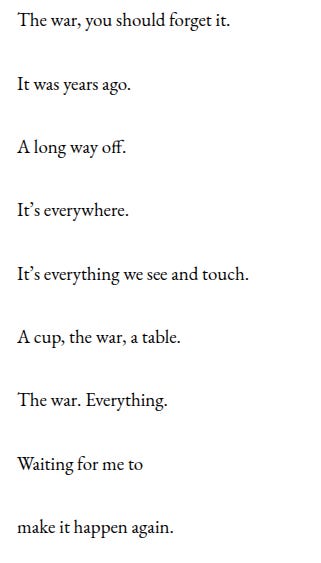
I actually made the obnoxious “poetry reading sound” (the appreciative “mmm”) while watching this scene. Sorry! Not sorry. There are moments like this throughout the script where it rises from its own grit and sparseness to approach the lyrical. Not to spoil a 3,000-year-old poem for you, but there are several fine moments like this that occur at the end when Penelope and Odysseus reunite. Plus Ralph Fiennes throws some furniture around looking for his marital bed, which is carved into a living Olive tree in the poem. It’s pretty hot.
Fiennes’ casting is great, and he provides the “ripped old guy” that I picture when reading The Odyssey. Some castings have the title character too young, but Odysseus has been gone at least 20 years: 10 years in Troy and 10 years trying to return from Troy. He left Ithaca when he was a young man but not so young: he was married and had an infant son. This means Odysseus is likely 40+, but in the Ancient Greece of Homer’s time, life expectancy was much shorter, so this guy is officially an old man.
Odysseus lands in Ithaca, spends 2 hours trying to get hold of himself and his literal home, roll credits. We spend more time with Laertes here (the old king and father of Odysseus), and Telemachus (played by a somewhat scenery-chewing Charlie Plummer) gets a lot of screen time, which distinguishes it from other adaptations.
Overall, the film is OK. It’s good enough. But I wouldn’t watch it again. For a Ralph Fiennes vehicle, this feels shocking, even to me.
Adaptation Roundup
In terms of faithfulness to the original, here’s how the adaptations I watched stack up in terms of plot points:
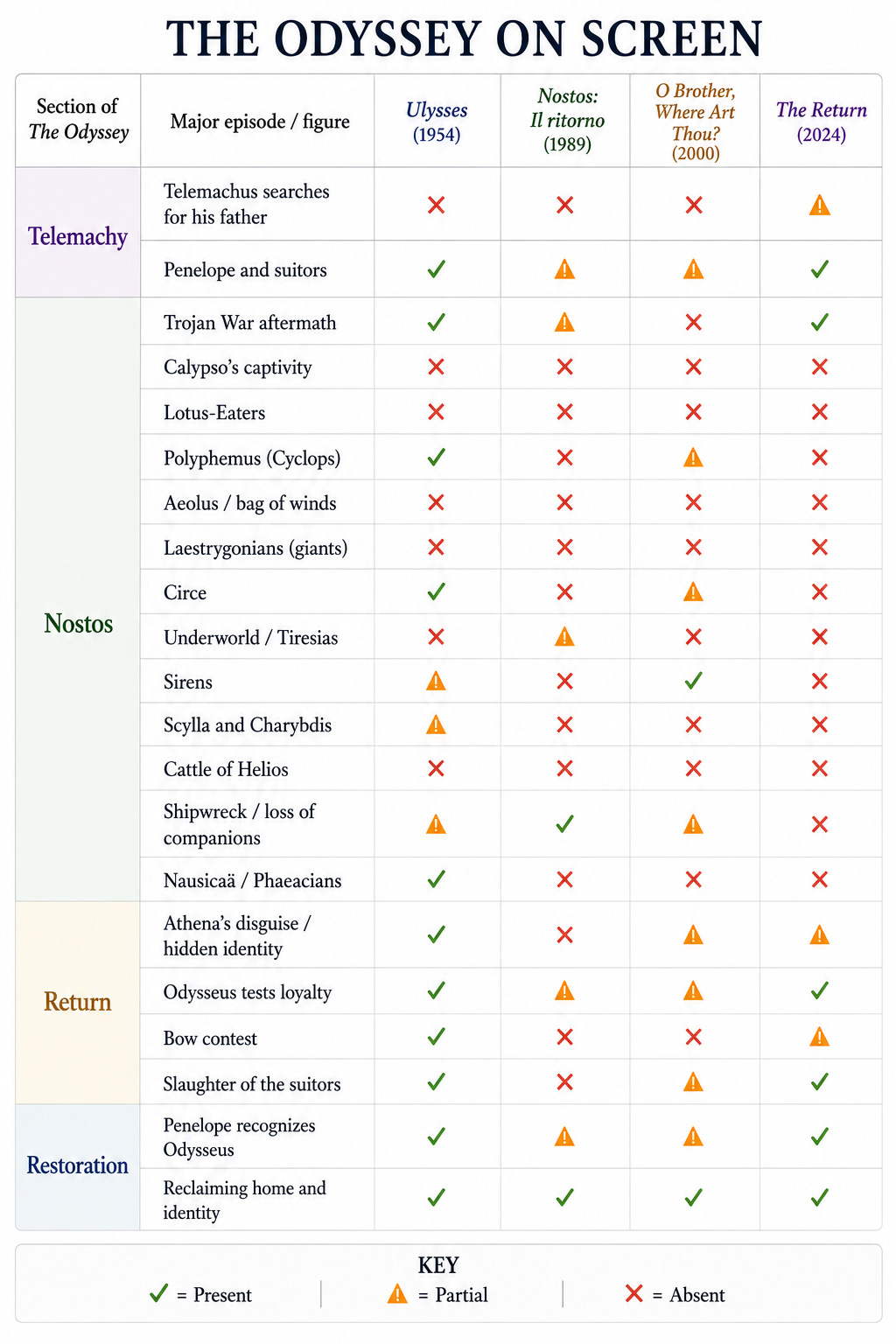
Ulysseus is the most faithful adaptation, but almost obsequiously so. Nostos and O Brother are very inventive, skipping many beats and riffing on Homer’s original in minimalist or highly original ways. The Return misses so many story beats because it is only interested in the homecoming portion.
Here’s how I’d rank the adaptations I watched in terms of their interest in language (the poetry dimension):
O Brother, Where Art Thou
The Return
Ulysses
Nostos: Il Ritorno
O Brother doesn’t contain poetry, but it does contain music, and the writing is damn good overall (A Coen Bros. strength). The Return has several nice poetic moments in the dialogue, but overall it’s much more toned-down verbally than O Brother. Last century’s Ulysses offers a blend of the idioms of its time and an inflated, artificial tone that doesn’t feel like poetry. Coupled with the fact that the actors weren’t speaking the same language on set, the result is very mixed. And lastly, Nostos, as I mentioned, contains an invented language and no subtitles, denying us an experience of poetry as we traditionally understand it (sure, call it visual poetry if you want).
What will Christopher Nolan do with his one wild and precious big budget poetry adaptation? I’ll be back next week to let you know.
Have you seen it yet?! Let me know in the comments when you do!


Have you heard the July 12 episode of the NY Times podcast, "The Daily": "What's Epic About the 'Odyssey'? Everything."
https://www.nytimes.com/2026/07/12/podcasts/the-daily/whats-epic-about-the-odyssey-everything.html
Host Natalie Kitroeff interviews Emily Wilson and novelist Madeline Miller ("Circe" and "Song of Achilles"). It's an epic episode (sorry), but Wilson left me worried that Nolan might not have spent any of his wild and precious millions on an actor to play Eurycleia.
I have tickets for a week from Wednesday, so I’ll learn about Eurycleia then — unless someone mentions it earlier (hint, hint).
Saw the Nolan film yesterday. Here's what he did with his 250 million wild and precious dollars: He spent almost three hours trying to compensate for a bland and often wooden script by using flashing lights and unbearable noise. (I brought earplugs but still had to hold my hands over my ears for most of the film.)
I'm sure you're following the fallout from Emily Wilson's brilliant essay in the London Review of Books. Unfortunately, many folks seem to be think she should sit down, shut up, and be grateful that Christopher Nolan is helping her sell books. Joyce Carol Oates chimed in yesterday: "her tone of dismissal & haughty superiority strike a sour note. rather than disagreeing with interpretations of Homer in a collegial manner."
Read: Sit down, shut up, and act more lady-like.
Don't listen to them, Dr. Wilson! Your tone is invigorating, and the film was a dog (apologies to Argos). I wasted a beautiful summer day on it.
https://x.com/JoyceCarolOates/status/2082476319078506731