
Netflix’s Sexy Vladimir Adaptation Is a Fiction Feast, with One Poetic Exception
You already knew that English was a very horny discipline, right? Right??


As a former college professor, I love seeing academia depicted on television almost as much as I love seeing poetry and poets discussed, and Netflix’s Rachel Weisz-led dramedy Vladimir, blessedly, gave me both.
Vladimir is a feast for the fiction lovers among us. Weisz’s character and her titular love interest are both novelists, and a Women in American Fiction course takes center stage while offering plenty of swoonworthy namedropping. The limited series adaptation of Julia May Jonas’ Vladimir contains only one moment when poetry takes center stage, albeit briefly. But you know me: I’ll take it.
The Novelist & The Poet
The show’s protagonist, known only as M (Weisz), is a professor and lapsed novelist at a nameless New England-ish college. She’s married to fellow professor John (John Slattery), a poet who happens to be the disgraced former chair of the department. After being accused of sleeping with countless students, John is asked to step down and faces a Title IX investigation. Though they privately have a quiet “arrangement” about sleeping with other people, M finds herself at the center of students’ bewilderment as they begin to ask bold questions about her reasons for remaining married to John. Meanwhile, M begins to drown in her sexual fantasies about the department’s newest character, Vladimir Vladinski (Leo Woodall), a hotshot young novelist who at first seems to only politely return her kindness. You know how the rest of this goes.
The show deals with female desire, the invisibility of women in middle age, questions of power and complicity, and the privilege of the elite. It’s extremely watchable, and god if I haven’t foudn myself trying to dress like M at work since I finished the show. Those blouses! A triumph.
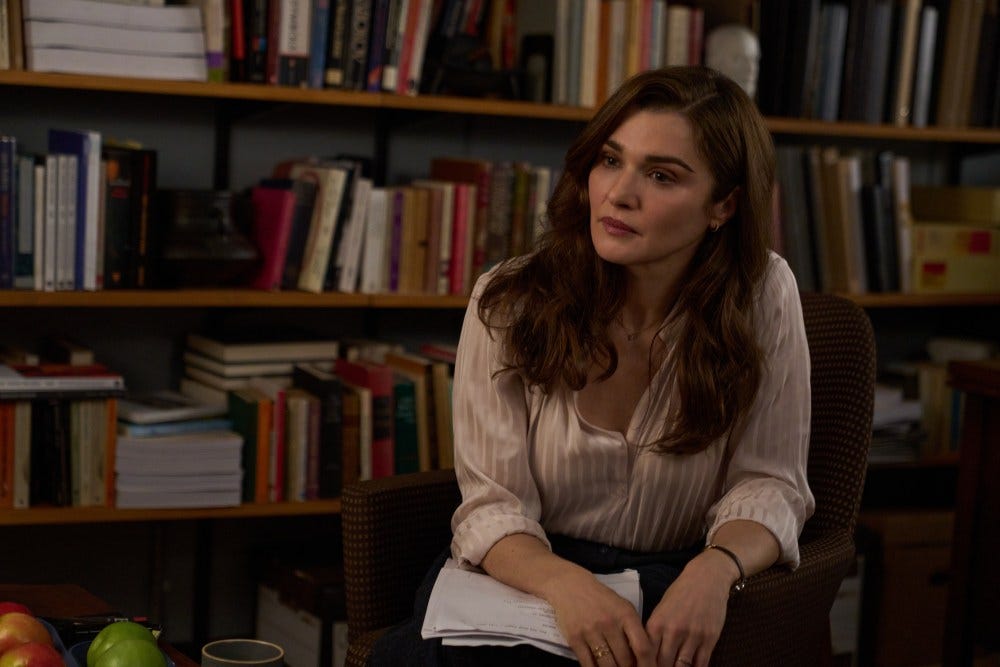
Part of me wonders if Slattery’s character was written as a poet to highlight his difference from his wife, his strangeness and otherworldliness, his strong sexual appetite. Are these clichés? But of course. Are they true of some poets? But of course.
When Vladimir meets John for the first time in earnest, he gushes about his admiration for the older academic. Vlad notes that he was a big fan of the book John is said to have written on “John Ashbery’s first collection.”
Is there anything interesting about this? If there is, you can bet I’m going to know or die trying to find out.
The Poet’s Poet
From my research, there are no real monographs on Some Trees, so this invention belongs solely in the world of Vladimir. Karin Roffman’s The Songs We Know Best might be a close analogue, but it’s more of a look at early Ashbery in general: a biography. Scholarly works on poets’ particular books are rare, and Ashbery is a real poet’s poet, a poet enjoyed by other poets but not as often read by members of the general public (if anyone is), so the idea that a professor would write a book solely on Ashbery’s debut is fairly esoteric.
John Ashbery’s first collection is one of his most well-known, but not for the reasons you want. Some Trees, first published in 1956, was famously (and controversially) selected to win the Yale Younger prize by none other than W. H. Auden.


How Auden came to select Ashbery’s book to win the prize is a weird story that would make today’s literary editors come out of their skin with its incestuous plot points (one hopes). Initially, Auden was so unimpressed with the quality of the works submitted for the prize that he wanted to decline to select a winner at all. Auden’s friend and partner, Chester Kallman, knew Ashbery and Frank O’Hara, who had also submitted to the contest (imagine passing on O’Hara for Ashbery! But I digress…) and urged Auden to reconsider, showing him Ashbery’s book in particular. He ended up picking Some Trees and wrote it a lukewarm preface.
I’m an Ashbery skeptic. His deeply mid first book was chosen under suspect circumstances to win a prestigious award that set him on a course for success. The literary establishment was then asked to take him seriously when what he put to paper was often mediocre and sometimes not even intelligible. His writing is wordy, often fully devoid of music, talky and erudite. To paraphrase Stephanie Burt, half the poetry world finds Ashbery to be incomprehensible while the other half adores him.
Read the title poem of the book and decide which half you belong to. Or if you’ve got a lot of time on your hands, read “Self-Portrait in a Convex Mirror,” the title poem of the book that won him a Pulitzer. I was tasked with reading it in graduate school and you can’t make me do it again.
The Poet and The Rest of Us
What frustrates me most about Ashbery is that readers routinely confuse his opacity for depth. Even Auden reportedly confessed that he didn’t understand portions of Some Trees, yet he still chose it to win the prize. This is a sore spot for me because I think that historically poetry’s conflation with arcanity—the idea that it has to be difficult or impossible to understand in order to qualify as poetry at all—has harmed the art form’s potential readership and helped it slip from public life.
Perhaps “difficulty” or incomprehensibility is perceived to be a hallmark of all art forms: think of the tired image of someone standing in front of a Pollock or a Rothko and saying, “I don’t get it.” Martha Graham’s choreo? Danny Kaye made fun of it in White Christmas. Marina Abramović staring down her viewers? Why? Your Boomer parents leaving the theatre after watching Midsommar going, “What was the point of that?”
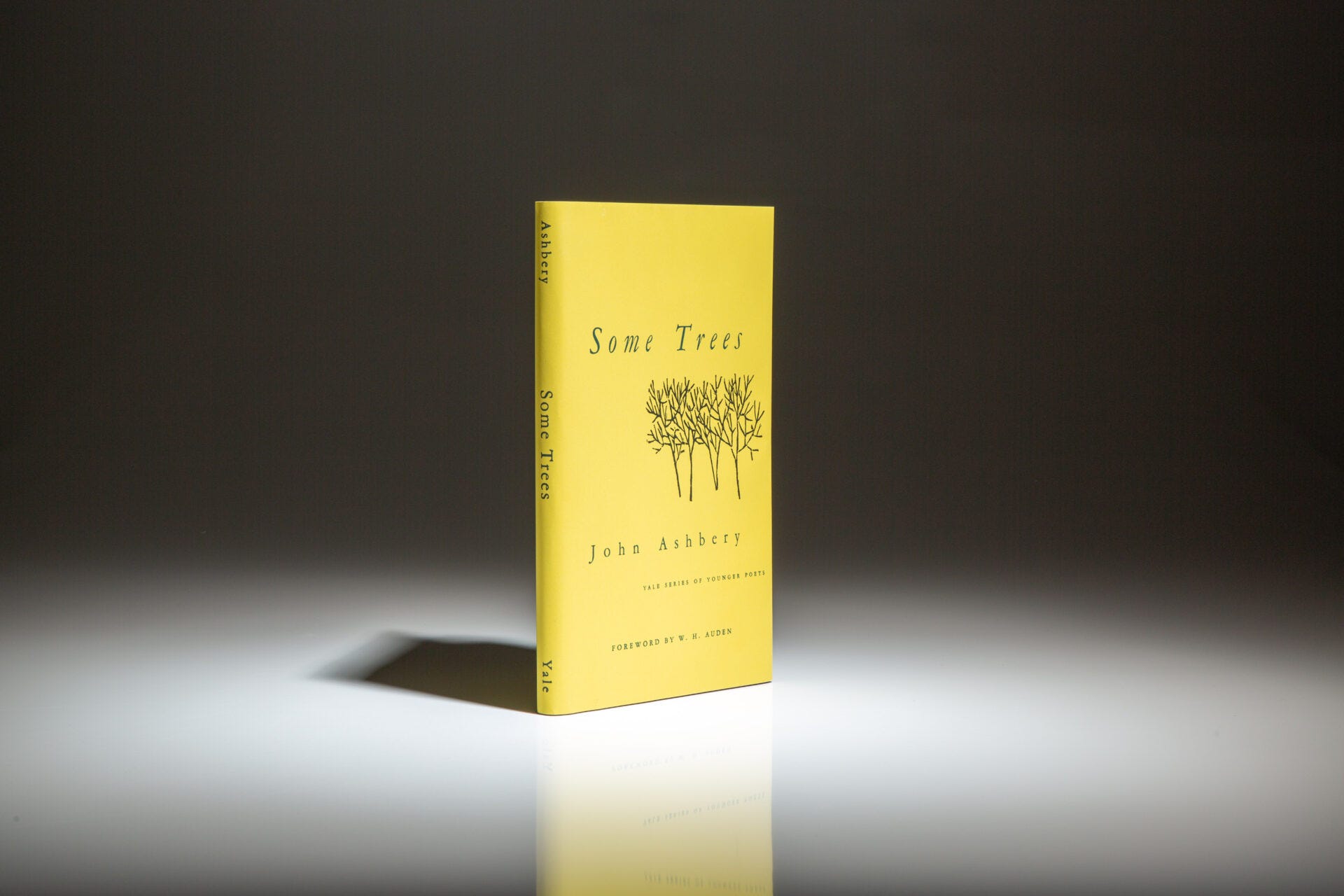
Is there a linkage between John the character on Vladimir, someone who seems like he’s great on the outside but is secretly not so great, and John the late American poet, whose CV seems impeccable but is secretly (or even openly) built on luck and connections and tiresome verbosity and Scotch tape?
You tell me.
P. S.
I’m sure you’ve heard that Billie Eilish is maybe doing an adaptation of The Bell Jar. I’m already exhausted.
Insert fart joke here.
Edward Norton recites Whitman on The Late Show is a sentence I’m very happy to be writing.
The Ashbery/Some Trees story is always fun, but it's not that unusual--in poetry land today, books are picked and published in much the same way. I'm a fan of Some Trees; I wrote my oral exam on it.