
Writing Prompt & Review: Del Toro's Frankenstein Airballs the Novel's Feminism
The horror icon made a controversial choice at the end of his creature feature based on the 19th century novel. Blink and you'll miss it, unless you're an English nerd!

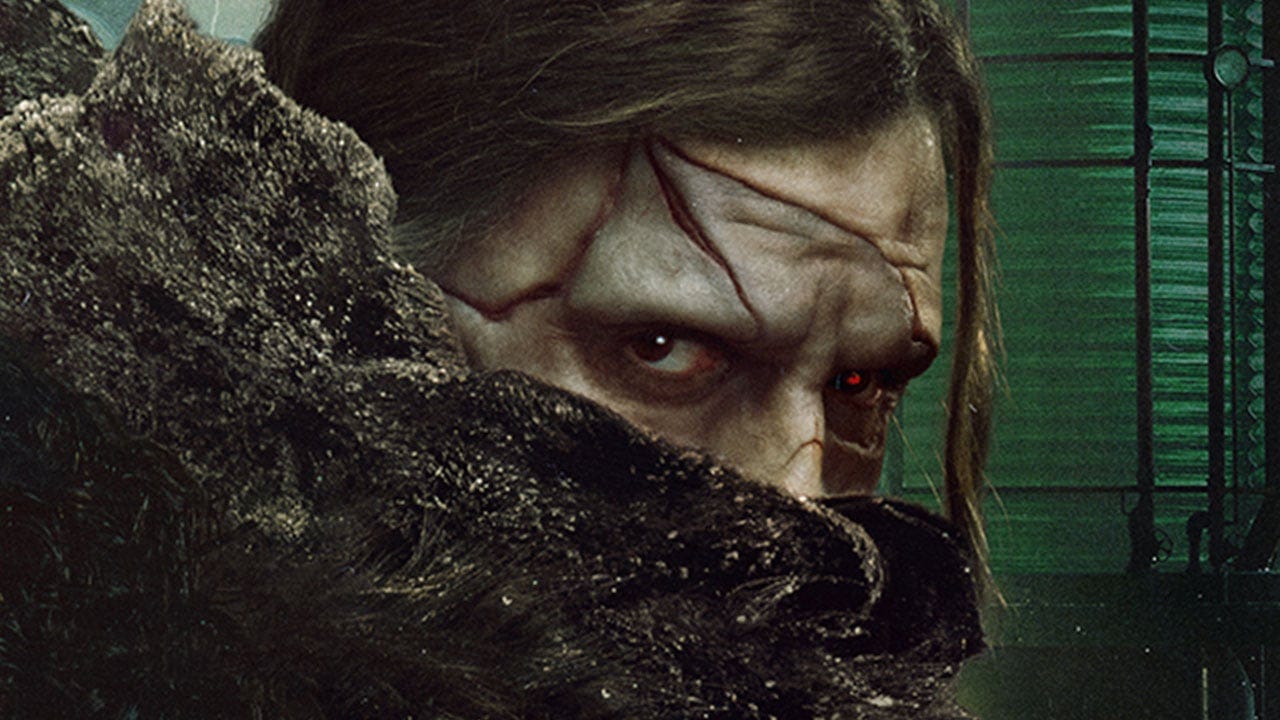
In this monstrous age, sexual attraction to so-called “hot monsters” feels downright normal. Robert Eggers’ Nosferatu broke our brains in 2024, and at the end of last year, we had Guillermo del Toro’s highly anticipated Frankenstein to contend with. Whether Jacob Elordi as the Creature, Oscar Isaac as Dr. Frankenstein, or Mia Goth as Elizabeth gets you hot under the collar, there’s plenty of visual interest in the film, which wants very much to be sexy. It wants, friends, to be a lot of things.
The film uses poetry on two occasions, and both those choices erase Mary Shelley.
Sadly, it isn’t very good.
Del Toro’s Frankenstein has been subject to a ton of hype, but overall, it’s more invested in its own style than in the substance of the source material. But then again, even the style is lacking at times. The CGI looks downright hokey at several points, including the wolf scenes and the scene where the monster basically surfs a wave out of a crumbling castle. And in that vein, the film uses poetry on two occasions, and both those choices serve the style of the film, but are hollow in terms of substance, erasing Mary Shelley from her own work, in a way.
Read on for a deep dive into the two poets Del Toro chose to highlight and a bonus writing prompt based on Mary Shelley’s groundbreaking novel.
Mary Shelley’s Frankenstein
Frankenstein, the novel first published in 1818, was famously written by a 19-year-old (!) Mary Wollstonecraft Shelley. It’s hard to overstate both how wonderful and strange the book is and how influential and important it has been since its first publication. The concept of the mad scientist? She invented that. A self-aware monstrous “creature” whose very nature is cursed? What would our culture even look like without them?
The novel is deeply feminist in ways that might be unclear to those who hear the name “Frankenstein” and think of Boris Karloff or some green-hued cartoon they might see at Halloween. Shelley was responding to the anxieties of her age as science and industry both exploded. Tellingly, she also imagines something terrible to contemplate as a woman in her time (and in ours): the obviation of human women from procreation. Dr. Frankenstein attempts to create life without the pesky requirement for a woman’s womb, and the results are both gruesome and heart-rending.


Victor Frankenstein technically succeeds in his endeavor to “create life” by animating dead tissue, but the cost of this technology is high. His struggle mirrors that of Prometheus, the titan who gave the fire of knowledge to mankind and paid his own awful price for the act, thus the novel’s subtitle, “The Modern Prometheus.” The male monsters suffer emotionally and existentially. Both are denied the love of a female partner, though in different ways. The mutual destruction of their brides-to-be locks these two wretched creatures in a final duel and sets them on a path to their demise.
Mary Shelley is a groundbreaking icon of literature, but she is often discussed in the same breath as her famous husband, the poet Percy Bysshe Shelley. In one sense, it’s a story as old as time: a talented woman obscured by her husband. But it’s a complex situation. Percy drowned off the coast of Italy at age 29; Mary lived to 53 and kept writing while devoting herself to publishing and championing Percy’s work. Mary’s own work did not receive comprehensive study until the 1970s.
What’s depressing is that Del Toro’s Frankenstein perpetrates the kind of minimization of Mary Shelley’s work that took more than 100 years to improve.
